For stem cell and regenerative practices

Fill your stem cell seminar. Then prove what it produced.

  • By Seminar Engine
  • Updated

The path

Five steps. Every one can leak.

Keep each handoff separate. A form submission is a registration, a reply can confirm the seat, and check-in records who attended. Consult bookings and patient outcomes require their own verified records.

  1. 01Ad click

    One condition, one event, one date. The ad sells the seat, not a treatment.

  2. 02Registered

    One event page records a seat request, contact details, source, and the guest’s consent choices.

  3. 03Confirmed

    Record the guest’s confirmation separately from the registration, with a monitored reply path.

  4. 04Attended

    Checked in at the door on a staff phone, with walk-ins and plus-ones recorded.

  5. 05Outcome recorded

    Staff verify consult bookings and patient status, keeping each outcome tied to its registration source.

Inspect the product

See where attendance becomes a record.

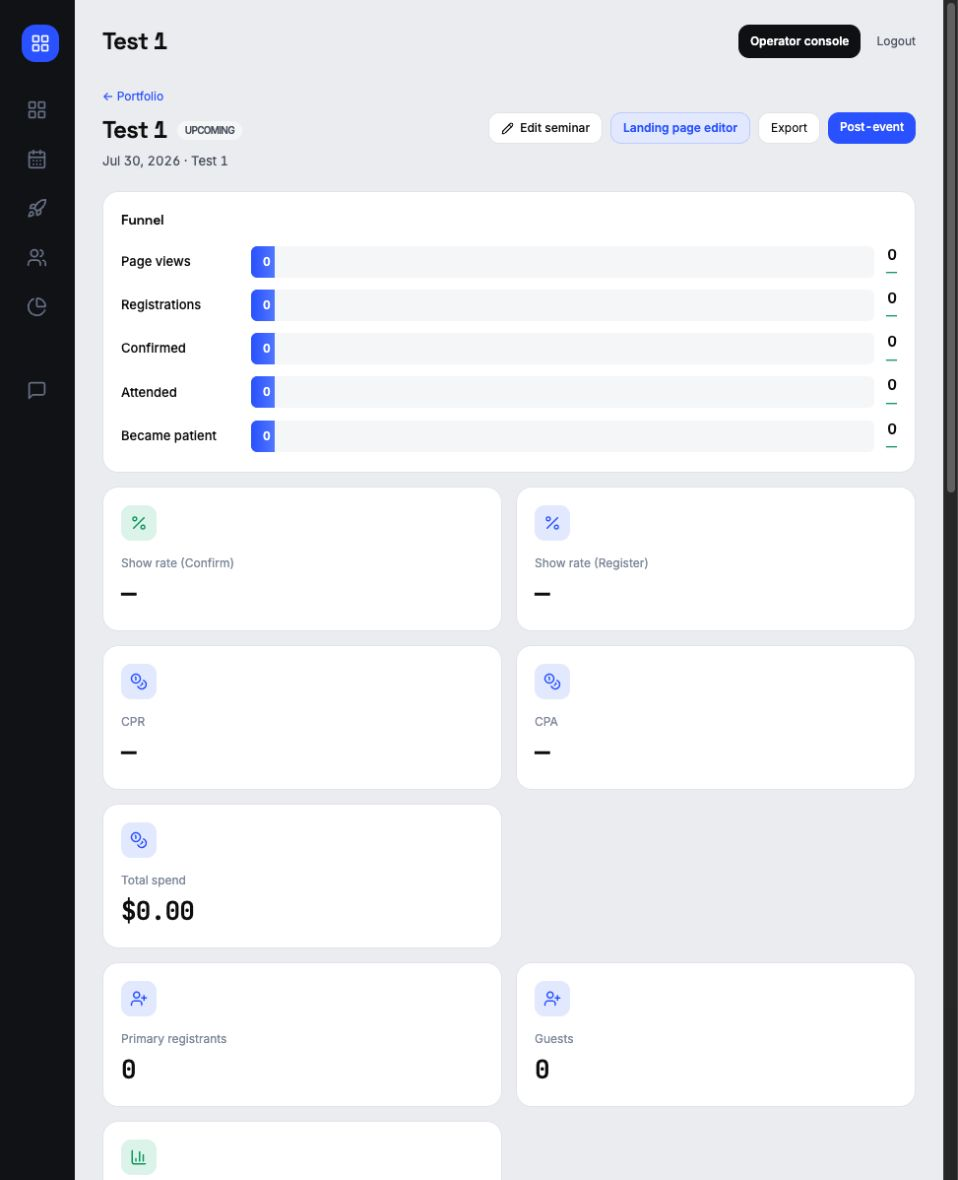
These stored test-screen captures show the actual staff check-in and event dashboard. The empty test event contains no client results. Interfaces may have changed since capture.
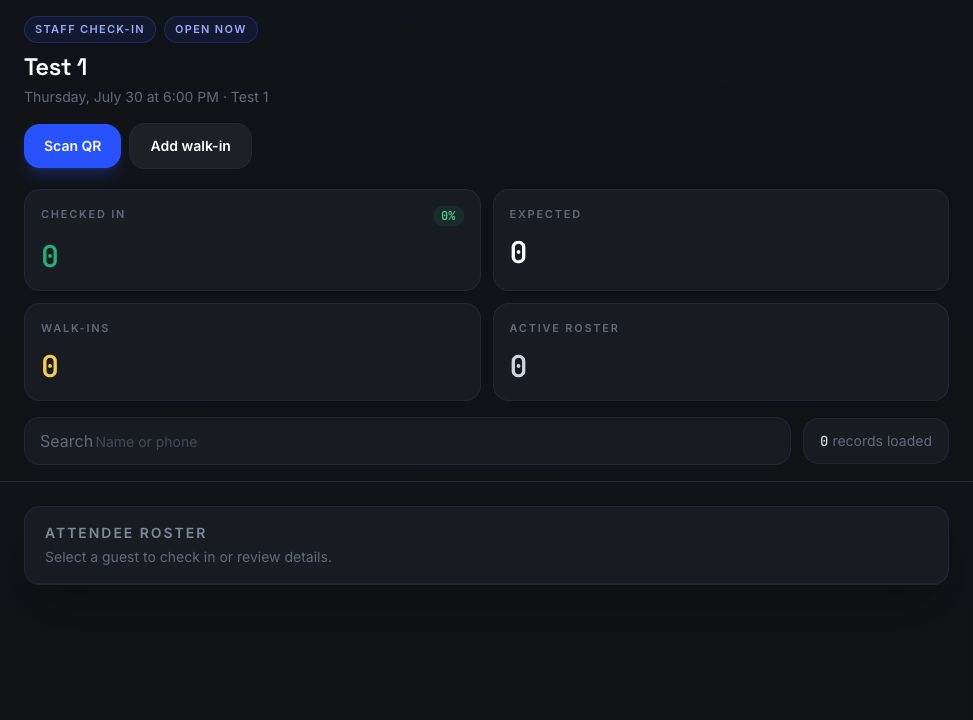
Stored staff check-in test screen with QR scan, add walk-in, search, and an empty attendee roster
Record arrival at the door. The test screen shows QR scan, add walk-in, and roster search. Empty counts describe this test event.
Stored event dashboard test screen showing separate page view, registration, confirmed, attended, and patient stages with no records
Keep the stages separate. The test dashboard distinguishes registrations, confirmations, attendance, and patient status. Its empty show-rate fields are not a measured zero rate.

Open either image to inspect it at full size. The event-night walkthrough explains check-in, and the post-event walkthrough explains the handoff into recorded outcomes. Synthetic walkthrough figures are examples, not client results.

Where the money goes

Check the handoffs around the room.

When a regenerative seminar comes in light, the instinct is to fix the talk. The people who didn't come never heard the talk. Look at these four places first.

The click

Compare sources using verified attendance and recorded outcomes. Cheap registrations alone cannot tell you which source brought guests to the room.

Track ads to patients

The 72 hours

Check the delay before the first useful reply, whether event details agree, and whether the guest confirmed the seat.

Fix no-shows

The door

A paper sign-in sheet misses walk-ins and plus-ones. You cannot follow up with people you never recorded.

Measure show rate

Why seminars

How do stem cell doctors fill patient seminars?

An educational seminar gives prospective patients time to hear the presenter and ask questions before deciding whether to request a consultation. Choose one condition or question the doctor can explain with clinic-approved language. The event is education, not a clinical assessment.

A seminar asks for less. Come hear the doctor. Bring your spouse. Ask your questions. A presentation can explain the topic; it cannot establish whether a treatment fits an individual. Clinical questions and later care decisions belong with qualified practice staff.

Keep one educational topic per room. The invitation should state the topic, presenter, date, and place without promising a treatment result. More in regenerative medicine seminar marketingand the basics in medical seminar marketing.

Decide whether an in-person room or online event fits the topic, travel area, presenter, and follow-up capacity. Review the format trade-offs indinner seminar vs webinar.

The system

Seven parts. One job.

Seminar Engine runs the whole chain as one managed system, operated by Boydston Marketing. You don't hire seven vendors or staff a software tool.

Demand
Meta ads with enough angles to find the buyer, not just the clicker. Built around one condition per room.
Registration
A branded page on your domain for one event. One promise, one path, fast on mobile.
Response
An SMS assistant trained on your seminar. It registers, confirms, cancels, adjusts guests, or passes a note to staff.
Attendance
Mobile check-in by QR scan or name lookup. Walk-ins and plus-ones captured without clipboard cleanup.
Attribution
Keep recorded outcomes attached to the registration source. Review missing or unmatched data before changing spend.
Reporting
Registrations, show rate, walk-ins, and cost per patient by source, campaign, and event.
Repeat
The next room reuses the page, creative, and tracking. New date, same system.

You keep the media accounts, the spend, the data, the landing assets, and the documentation. The first room is normally live in 30 to 45 days.

Claims

Sell the seminar. Not the outcome.

Stem cell marketing is policed by the FDA, the FTC, and state attorneys general. Keep the invitation factual and educational: the topic, date, place, and presenter. Clinic approval and appropriate professional review still apply to every medical claim.

Seminar Engine builds the page, runs the ads, and measures the room. It does not write medical claims. Your clinic approves its medical language and owns it.

The FDA and FTC sources, in plain English, are inhow to market stem cell therapy legally. It is not legal advice. Your healthcare attorney signs off on claims.

The math

Cost per patient, not cost per click.

Add every cost for the room: ad spend, venue, food, staff time, and management. Divide by verified new patients from that room when that count is available and greater than zero. If patient outcomes are missing, keep cost per patient unknown and inspect the earlier measured stages.

In the illustrative room above, 10 of 42 registrants never came. That is ad spend that did not produce attendance in that example. That does not tell you why each person stayed home or what caused any later outcome. The worked example is inwhat a patient seminar costs, and the attendance math is in what a good seminar show rate looks like. Run your own room's counts in the seminar show rate calculator.

Choosing a partner

What makes the best seminar marketing company for stem cell clinics?

The best seminar marketing company for stem cell clinics can show the path it operates: advertising, registration, consent-aware replies, reminders, check-in, and recorded consult outcomes. Compare its price, clinic approval responsibilities, and account and data ownership. Inspect those handoffs with a test event before treating any demonstration as outcome evidence.

That is how we work: $7,500 to launch, including the first room, with ad spend paid directly to Meta and Google and every medical claim approved by your clinic. Compare the three ways to staff it inagency vs in-house vs ads alone, or check six companies against published criteria inour company checklist.

Public pricing

Launch once.
Then pick a cadence.

The launch builds the system and runs the first event. Every cadence after that reuses what worked instead of rebuilding from zero, so each room costs less time, less chaos, and less money to fill.

Step 1 · Launch the system

Launch the system and run the first seminar.

The launch includes the buildout and first live seminar run: branded page, ads, seminar-trained SMS assistant, reminders, mobile check-in, attribution, dashboard, staff training, and a post-event readout you can take to the bank.

$7,500one-time

What you walk away owning

  • The full Seminar Engine built for one defined, high-value offer
  • Branded registration page on your domain, production-ready, not a template dump
  • AI SMS assistant trained on your seminar topic, offer, and objections
  • Ad creative pack with enough angles to find the buyer, not just the clicker
  • Confirmation and reminder cadences that protect show rate
  • Post-event nurture for no-shows and fence-sitters who did not book on the night
  • Mobile check-in for attendance, walk-ins, and plus-ones, no clipboard reconciliation
  • Live event dashboard and source-level reporting down to cost per patient
See the complete launch scope →
Bought separately, the core build is roughly $10,300–$15,700. The launch is bundled because half-built systems leak registrations, show rate, and patient revenue.
Step 2

Plan a year of seminars, one every six weeks.

Ad spend is paid directly to Meta and Google.

À la carte

No commitment

$4,000/ seminar

$4,000 per seminar

Why every six weeks: ads need about two weeks to ramp, registration runs two to three more, then the room, then follow-up with no-shows before the next campaign starts. Monthly runs stack those steps on top of each other. We scope more than one room per cycle, or several locations, on the audit.

What a cadence means

A cadence is a managed repeat run of the system built during launch: the same core offer, audience, market, registration path, tracking, response system, and follow-up architecture, operated again with updated date, venue, capacity, and budget.

What it does not mean

A new topic, service line, materially different audience or market, or substantially different funnel is a new launch or separately scoped expansion.

Standard first year

Launch, then a nine-seminar season.

The $7,500 launch includes the first seminar. The season starts after that room: 9 more seminars over 12 months, about one every six weeks, at $1,500 a month. That is 10 seminars for $25,500, plus ad spend paid directly from your media account.

First year · 10 seminars$25,500plus ad spend

Start by finding the leaks in the current seminar path, then see what a filled room looks like on the real system.

Guides

One leak per guide.

GuideMedical Practice Marketing: Where Patient Seminars FitMedical practice marketing for established practices: what search, reviews, and referrals do, where they stall on high-consideration care, and how seminars fill the gap.Read the guide GuideDental Implant Marketing: Build the Path From Ad to ConsultA dental implant marketing plan that moves prospects from an approved ad to a patient seminar, registration, attendance, and a measured consultation path.Read the guide GuideMedical Weight Loss Marketing: Lead With Patient EducationA medical weight loss marketing plan built around one educational seminar, approved claims, a focused registration path, attendance, and measured follow-up.Read the guide GuideStem Cell Marketing Plan: One Condition, One Room, One ScoreboardBuild a stem cell marketing plan around one seminar, approved claims, a focused registration path, attendance records, and verified patient outcomes.Read the guide GuideMedical Seminar Marketing: What the Best Service Does for PracticesWhat the best medical seminar marketing service for medical practices does: why seminars beat cold ads, the five steps to a patient, and where rooms leak.Read the guide GuideHow to Market a Medical Seminar: Build the Whole Patient PathHow to market a medical seminar by connecting the offer, audience, registration page, follow-up, room, and patient attribution in one plan.Read the guide GuideHow to Promote a Medical Seminar: Plan Backward From the RoomHow to promote a medical seminar as one connected campaign, from the offer and registration page through replies, reminders, check-in, and patient tracking.Read the guide GuideSeminar Management Software: A Buyer’s ChecklistChoose seminar management software by testing registration, replies, reminders, check-in, follow-up, account ownership, and source-level reporting.Read the guide GuideSeminar Registration Page: Turn Clicks Into Confirmed SeatsA seminar registration page has one job: carry a paid click into a confirmed seat. Use this page, form, consent, reply, reminder, and tracking checklist.Read the guide GuideSeminar Confirmation Email: What to Send After Someone RegistersWrite a seminar confirmation email that carries the date, time, address, parking, reply path, and calendar add, then turn the reply into a confirmed seat.Read the guide GuideSeminar Reminder Email: What to Send Before the EventWrite a seminar reminder email that keeps the date, time, location, reply path, and attendance handoff clear from registration through event day.Read the guide GuideSeminar Follow-Up Email: What to Send After the EventWrite seminar follow-up emails for attendees, no-shows, and people who already booked, with one next step and one owner for every reply.Read the guide GuideRegenerative Medicine Marketing Agency Guide: PRP and Stem Cell Patient SeminarsWhat the best regenerative medicine marketing agency for patient seminars does for PRP and orthobiologics practices: one condition per room, claims, and tracking.Read the guide GuideWhat Is a Good Show Rate for a Free Medical Seminar?There is no honest universal benchmark for medical seminar show rate. How to measure yours, what each no-show costs, and the reminder cadence that protects attendance.Read the guide GuideSeminar No-Shows: Why Registrants Don't Come and How to Reduce ThemHow to reduce no-shows at medical patient seminars: they start in the 72 hours after registration. The reply, reminder, and follow-up steps that win registrants back.Read the guide GuideFacebook Ads for Medical Seminars That Fill the Room, Tracked to the PatientHow to run Facebook and Instagram ads for a medical seminar and track each click through registration, attendance, and the patient, so you know which ads to cut.Read the guide GuideWebinar vs Seminar: The Best Way to Run Dinner Seminars for a Medical PracticeWebinar vs seminar for regenerative medicine patients: how the two formats compare on cost, commitment, attendance, and consults, and when each one earns its place.Read the guide GuideWhat Does a Patient Education Seminar Cost? The Per-Patient MathWhat a patient education seminar costs and how to track cost per new patient from medical seminars: ad spend, venue, food, staff, and management, with illustrative math.Read the guide GuideBest Medical Seminar Marketing Companies: A Buyer’s ChecklistCompare medical seminar marketing companies using their published scope, pricing, ownership statements, and questions to verify. Sources checked October 22, 2026.Read the guide GuideSeminar Marketing Agency vs In-House vs Ads Alone for Medical PracticesAlternatives for medical practice seminars: hire a seminar marketing agency, build in-house, or run ads alone. Compare speed, ownership, tracking, claims, and cost.Read the guide GuideHow to Market Stem Cell Therapy Legally: What Your Ads Can't SayHow to market stem cell therapy legally, in plain English: what the FDA and FTC say, what an ad cannot claim, and links to the sources. Not legal advice.Read the guide GuideFinancial Seminar Marketing: Measure the Whole Path From Ad to AppointmentMarket a financial or retirement seminar as one path: a single offer, firm-approved ads, registration, reminders, check-in, and follow-up tied to booked meetings.Read the guide GuideMedical Seminar Invitation: Five Parts That Get Patients to RegisterA medical seminar invitation needs five parts: who it is for, one topic, date and place, what happens in the room, and one way to register. Example included.Read the guide GuideSeminar Attendance Sheet: What the Record Needs and a Layout to CopyA seminar attendance sheet should record five things per person: registered, attended, walk-in, plus-one, and source. Copy the layout, then see where paper breaks.Read the guide GuideHow to Fill a Seminar: Work Backward From the SeatsHow to fill a seminar: start from the seats, divide by your measured show rate, and size lead flow and reminders to match. Includes a worksheet with example math.Read the guide GuideRetirement Planning Seminar: Plan One That Ends in Booked AppointmentsPlan a retirement planning seminar for your advisory firm: one topic, a plain agenda, compliance review, reminders, check-in, and follow-up tied to booked meetings.Read the guide GuideHair Restoration Marketing: Build a Seminar Path to the ConsultationPlan hair restoration marketing around a patient education seminar: approved invitations, registration, reminders, check-in, and consultation follow-up by source.Read the guide GuideEvent Check-In App: What It Must Record at the DoorChoose an event check-in app by what it records at the door: name lookup, walk-ins, plus-ones, and the source behind each arrival. Use the checklist before you buy.Read the guide

Questions

Before the audit.

More answers on the FAQ page.

What must the clinic provide before launch?

A defined offer, presenter, event date and venue, account access, timely approvals, and an ad budget. The clinic approves medical language and consent. A new topic, audience, market, or substantially different funnel needs a new launch or separate scope.

Can I inspect the registration-to-outcome workflow?

The walkthrough shows how the managed system fits together. The test-screen captures on this page show staff check-in and the event dashboard with empty test records. They are stored product captures, not client results or a promise that every interface is unchanged today.

Does a confirmation prove attendance or a new patient?

No. Registration, confirmation, attendance, consult booking, and patient status are separate records. Attendance comes from check-in, while consult and patient outcomes need staff verification. Missing outcomes stay unknown; they should not be inferred from clicks, replies, or message delivery.

How do stem cell clinics fill patient seminars?

Start with one clinic-approved educational offer, one event page, and a consent-appropriate confirmation path. Connect reminders, recorded check-in, consult bookings, and patient outcomes to the original source. That gives the practice a process to inspect; it does not promise a filled room or patient count.

What does Seminar Engine cost for a stem cell practice?

$7,500 to launch, including the first seminar. Then $4,000 per seminar à la carte, or the annual season: 9 seminars at $2,000 each, billed $1,500 a month. Ad spend is separate and paid directly to Meta and Google.

Does Seminar Engine write medical claims for my clinic?

No. We build the page, run the ads, and measure the room. Your clinic approves its medical language and owns its claims. Talk to your healthcare attorney about what you can say about regenerative treatments.

How fast can a stem cell practice go live?

The first room is normally live in 30 to 45 days. Speed depends on account access, a locked offer and date, timely approvals, and an ad budget the platforms can learn from.

Do you promise a full room?

No. Results depend on your offer, market, budget, and approvals. The free audit checks whether the math supports a filled room before you spend money on one.

Free 30-minute audit

Find the leaks before you buy another room.

Free, 30 minutes, on video with Robert. He reviews your ad account, registration page, follow-up speed, and tracking from lead to patient. You leave with three to five specific fixes and what each one is likely costing you per month.

Book the free audit