For practices that run patient seminars
Fill the seats
you paid for.
Boydston Marketing runs your seminar ads, registration, reminders, and check-in through Seminar Engine. See who registered, who attended, and what happened next.
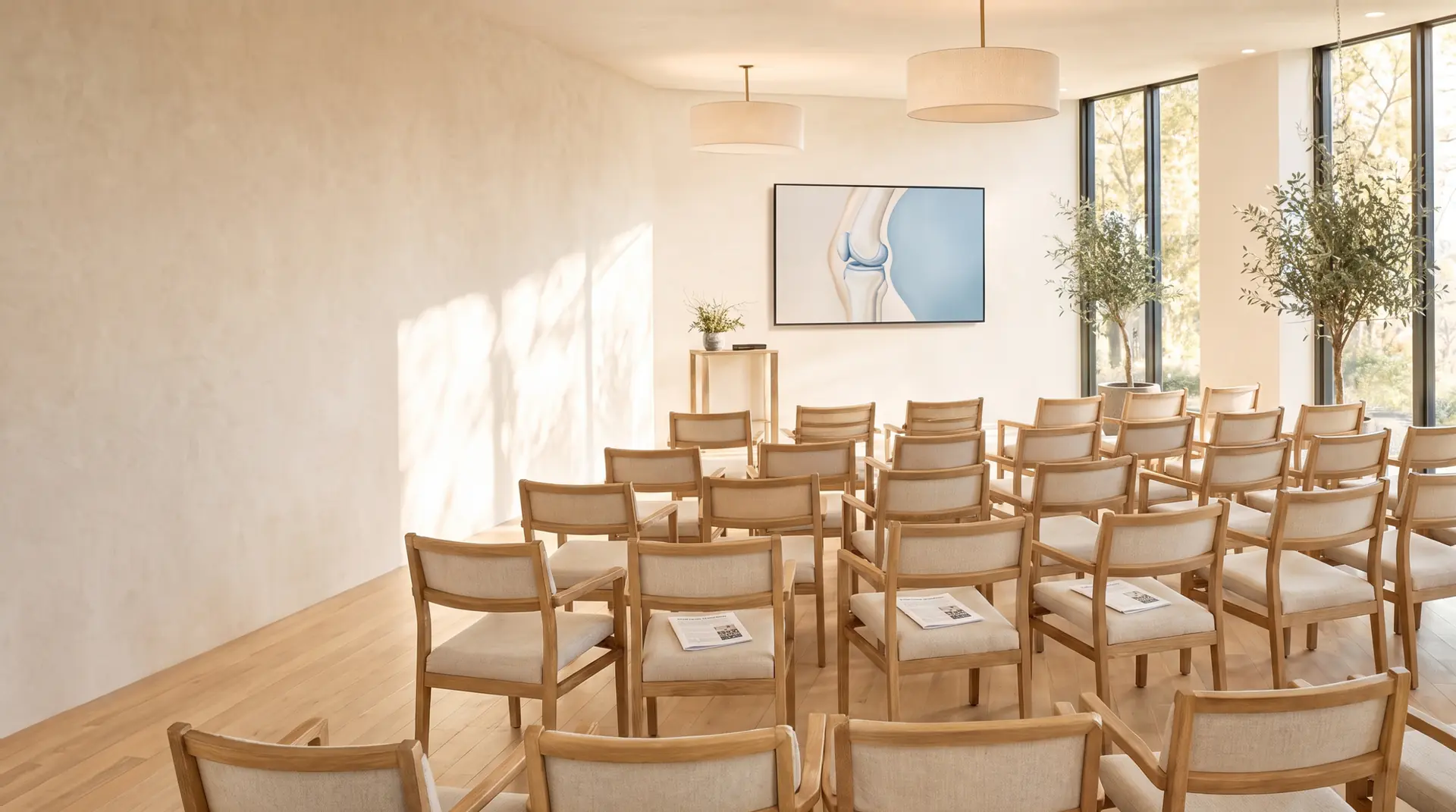

Full VSL · 4:47
The room builds trust. The system carries the next step.
Watch how Seminar Engine connects the five handoffs from ad click to patient outcome, then keeps the practice in control of the accounts, data, and follow-up.
Book the 30-minute auditWatch on YouTube
Read the transcript
Cold open: the room
Hormozi is right about the room. But the room is not the system.
For a stem cell or regenerative practice, the doctor gets to teach before the patient is asked to decide.
The room builds trust and answers questions a cold ad cannot. Patients can understand the problem, the options, and the next step before making a decision.
A good presentation cannot rescue a broken path. If the click, reply, reminder, check-in, or follow-up fails, the room never gets its chance.
The five handoffs
A seminar runs across 5 connected stops. Ad click. Registered. Confirmed. Attended. Patient. The money leaks between them.
First, the click must become a registration. A patient lands on a phone and decides in seconds whether the event feels clear, local, and worth an evening.
Next, registration must become a conversation. They may ask about parking, a guest, or the topic. Silence turns fresh intent into tomorrow's forgotten tab.
Confirmed must mean more than a spreadsheet row. Clear details, timely reminders, and easy updates keep the event alive.
At the door, the front desk needs clean data: who arrived, brought a guest, walked in, or never made it.
After the room, attendees, no-shows, and fence-sitters need different follow-up. None should disappear into a paper sign-in sheet.
Across all 5 stops, the practice must know which source produced the patient. Otherwise, the next budget is a guess.
The connected system
Seminar Engine connects that path. I run the managed acquisition system through my company, Boydston Marketing, so your staff is not left assembling another dashboard.
Demand starts with ad creative built around one high-value offer. It should find the person who belongs in the room, not chase an empty click.
Registration runs through a branded page on the practice's domain, built for the event and fast on a phone. One promise. One path.
A seminar-trained SMS assistant responds while the lead still cares. It answers event questions, confirms reservations, adjusts guest count, and passes notes to staff.
Confirmations and reminders protect the path to the room. Mobile check-in records attendees, walk-ins, and plus-ones without next-morning clipboard cleanup.
Every registration stays tied to its source through attendance and patient outcome. The dashboard shows what moved and where the process broke.
Follow-up splits by what happened. Attendees get the next step. No-shows get another path. Fence-sitters are not treated like strangers.
Ownership and objections
The practice keeps its media accounts, spend, data, landing assets, and patient relationships. I operate the system through Boydston Marketing. The practice owns it.
An existing agency can keep the website, search, branding, and everyday ads. Seminar Engine owns the seminar path from paid attention to measured follow-up.
If seminars failed before, find the break. Registrations may have stalled, confirmed guests may not have arrived, or follow-up may have vanished. Each failure needs a different fix.
The staff could piece it together. Their job should be serving patients and running the event, not stitching ads, forms, texts, check-in, spreadsheets, and attribution together.
Fit and the hard stop
It fits established teams with one high-value educational offer, a provider who can teach, enough demand and ad budget to fill a room, and the discipline to repeat what works.
If the math cannot support the room, the audit can recommend a hard stop. There is no promise of registrations, attendance, patients, or revenue. Qualify the model before spending more.
The public offer
The launch is $7,500, one time. It includes the complete buildout and the first live seminar: page, ads, SMS assistant, reminders, check-in, dashboard, staff training, and post-event readout.
After launch, practices can run à la carte at $4,000 per seminar, or choose the recommended annual season: 9 seminars a year, about one every 6 weeks, billed at $1,500 a month. Ad spend is paid directly to Meta and Google with no markup.
The normal implementation window is 30 to 45 days, depending on account access, a locked offer and date, approvals, and enough budget for the platforms to learn.
Close: the audit
The next step is a free 30-minute audit with me, Robert Boydston. I review the budget, mobile path, follow-up speed, tracking, and seminar economics.
The practice leaves with 3 to 5 specific fixes and what each is likely costing per month. Even if Seminar Engine is not the next move, the fixes remain theirs.
The room can build trust. The system gets the right people there and follows every outcome. Book the audit at seminarengine.com.
The problem
An empty chair isn't free. You already paid for it.
Every empty seat is ad money you already spent, and when the ad rep says the campaign "performed well," you have no way to check. It isn't your team's fault. It's the leaks between disconnected tools.
01AttentionPaid demand
02RegistrationSingle path
03AttendanceProtected intent
04OutcomeTraceable value
05RepeatCompounding system
The engine
Seven parts.
One job.
Seminars are all we do. One connected system, run end to end, so nothing falls between vendors.
Connected path from ad click to repeat event
- 01DemandAds built to buy patients, not clicks.
- 02RegistrationA registration page that does not leak intent.
- 03ResponseYour SMS assistant while the lead still cares.
- 04AttendanceCheck-in that runs cleanly on event night.
- 05AttributionAttribution that tells you what to kill and scale.
- 06ReportingA dashboard that ends the guessing.
- 07RepeatA cadence you can repeat without rebuilding.
Ads built to buy patients, not clicks.
Copy, creative, budgets, and daily pacing built around qualified people in seats.
A registration page that does not leak intent.
One event, one promise, one path. Fast on mobile and branded to the practice.
Your SMS assistant while the lead still cares.
Instant replies trained on your seminar: register, confirm, cancel, adjust guests, or pass a note to staff.
Check-in that runs cleanly on event night.
QR scan or name lookup. Walk-ins and plus-ones captured without clipboard cleanup.
Attribution that tells you what to kill and scale.
Outcomes stay tied to source so spend decisions are not emotional.
| Campaign | Spend | Attended | Patients | Cost / patient |
|---|---|---|---|---|
| Meta · bone-on-bone v2 | $1,632 | 18 | 4 | $408 |
| Google · knee pain | $640 | 9 | 2 | $320 |
| Referral | $0 | 5 | 0 | n/a |
| All sources | $2,272 | 32 | 6 | $379 |
A dashboard that ends the guessing.
Registrations, show rate, walk-ins, and cost per patient by source, campaign, and event.
Action Center2 items need attention
- Confirm venue capacity for Mar 14 seminar
- Review pacing: 31 seats · 18 days out
90-day show rate83%
Cost per registration$47
Active seminars2
Registrations (90d)186
A cadence you can repeat without rebuilding.
Templates, repeat events, and a post-event readout make the next room easier to fill.
Seminars rarely fail at the presentation.
They fail in the small gaps that look harmless until the room is half empty.
01
Registration
No exits between the ad and the seat.
Interested people get one clear next step instead of a general website full of exits.
02
Show rate
Follow-up starts the minute they register.
Confirm while intent is hot, let the SMS assistant answer questions, and keep the event alive until the guest arrives.
03
Staff time
No clipboard cleanup.
No manual form chasing, plus-one reconciliation, or waitlist sorting.
04
Ad spend
Every result stays tied to its ad.
The system keeps the path from click to seated guest, consult, and patient, so spend decisions rest on what each ad produced.
What changes
Seminar night, the way it should feel.
Confirmations go out the minute people register. Questions get answered by text. Guests check in on a phone, and the next morning you know who came, who booked a consult, and which ad brought them.
76%Illustrative show rate
A room you can plan around.
Confirmations go out the minute people register, so you know who is coming before event week.
−12hEstimated staff time
Your team gets the day back.
The front desk serves patients instead of chasing registrations and fixing sign-in sheets.
$71Illustrative cost / attendee
Spend decisions made on facts.
Cost per attendee and cost per patient by ad, so you know what to keep and what to cut.
↻Repeat
A system that compounds.
Every seminar makes the next one easier to fill.
From a practice that hopes the room fills, to a practice that can see what filled it and prove what each seminar was worth.
Illustrative outcomes
What one room looks like when you can see all of it.
These figures come from a synthetic campaign walkthrough, not a guarantee. They show what becomes visible when the full path is managed: registrations, attendance, consults, and patients tied back to the source that bought them.
From one offer, one page, one path
Checked in on staff phones, not clipboards
Within 7 days of the event
Traceable to ad source and campaign
Illustrative demo data. Your market, offer, and case acceptance drive the real outcome.
Public pricing
Launch once.
Then pick a cadence.
The launch builds the system and runs the first event. Every cadence after that reuses what worked instead of rebuilding from zero, so each room costs less time, less chaos, and less money to fill.
Step 1 · Launch the system
Launch the system and run the first seminar.
The launch includes the buildout and first live seminar run: branded page, ads, seminar-trained SMS assistant, reminders, mobile check-in, attribution, dashboard, staff training, and a post-event readout you can take to the bank.
$7,500one-time
What you walk away owning
- The full Seminar Engine built for one defined, high-value offer
- Branded registration page on your domain, production-ready, not a template dump
- AI SMS assistant trained on your seminar topic, offer, and objections
- Ad creative pack with enough angles to find the buyer, not just the clicker
- Confirmation and reminder cadences that protect show rate
- Post-event nurture for no-shows and fence-sitters who did not book on the night
- Mobile check-in for attendance, walk-ins, and plus-ones, no clipboard reconciliation
- Live event dashboard and source-level reporting down to cost per patient
Bought separately, the core build is roughly $10,300–$15,700. The launch is bundled because half-built systems leak registrations, show rate, and patient revenue.
Step 2
Plan a year of seminars, one every six weeks.
Ad spend is paid directly to Meta and Google.
À la carte
No commitment
$4,000/ seminar
$4,000 per seminar
Annual season
9 seminars / year · about every 6 weeks
$1,500/ month · 12 payments
$2,000 per seminar · $18,000 / year
Why every six weeks: ads need about two weeks to ramp, registration runs two to three more, then the room, then follow-up with no-shows before the next campaign starts. Monthly runs stack those steps on top of each other. We scope more than one room per cycle, or several locations, on the audit.
What a cadence means
A cadence is a managed repeat run of the system built during launch: the same core offer, audience, market, registration path, tracking, response system, and follow-up architecture, operated again with updated date, venue, capacity, and budget.
What it does not mean
A new topic, service line, materially different audience or market, or substantially different funnel is a new launch or separately scoped expansion.
Standard first year
Launch, then a nine-seminar season.
The $7,500 launch includes the first seminar. The season starts after that room: 9 more seminars over 12 months, about one every six weeks, at $1,500 a month. That is 10 seminars for $25,500, plus ad spend paid directly from your media account.
First year · 10 seminars$25,500plus ad spend
Start by finding the leaks in the current seminar path, then see what a filled room looks like on the real system.
How it works
A clear path to your next seminar.
Start with the audit. See what needs fixing, agree on one seminar offer, then run and measure the room. You keep your accounts and data.
Start here
Audit your seminar path
Review your offer, ads, registration, follow-up, and tracking with Robert. Leave the free 30-minute call with three to five specific fixes.
Normally 30–45 days to the first room
Launch one connected system
If the fit and budget work, build and run your first seminar around one defined offer. Timing depends on account access, approvals, and ad budget.
After the seminar
Review the room
Record attendance and outcomes, review the numbers, and decide what to change before the next seminar run.
One thing to know
The launch includes one round of landing-page revisions. Additional rounds are priced separately or rolled into the next cadence. That keeps the first event on the calendar instead of stuck in committee.
The first step
Find the leaks before you buy another room.
We look at the ad account, page, response path, tracking, and seminar economics. You leave with the first three to five fixes we would make, whether or not you hire us, and a clear read on whether the math works.